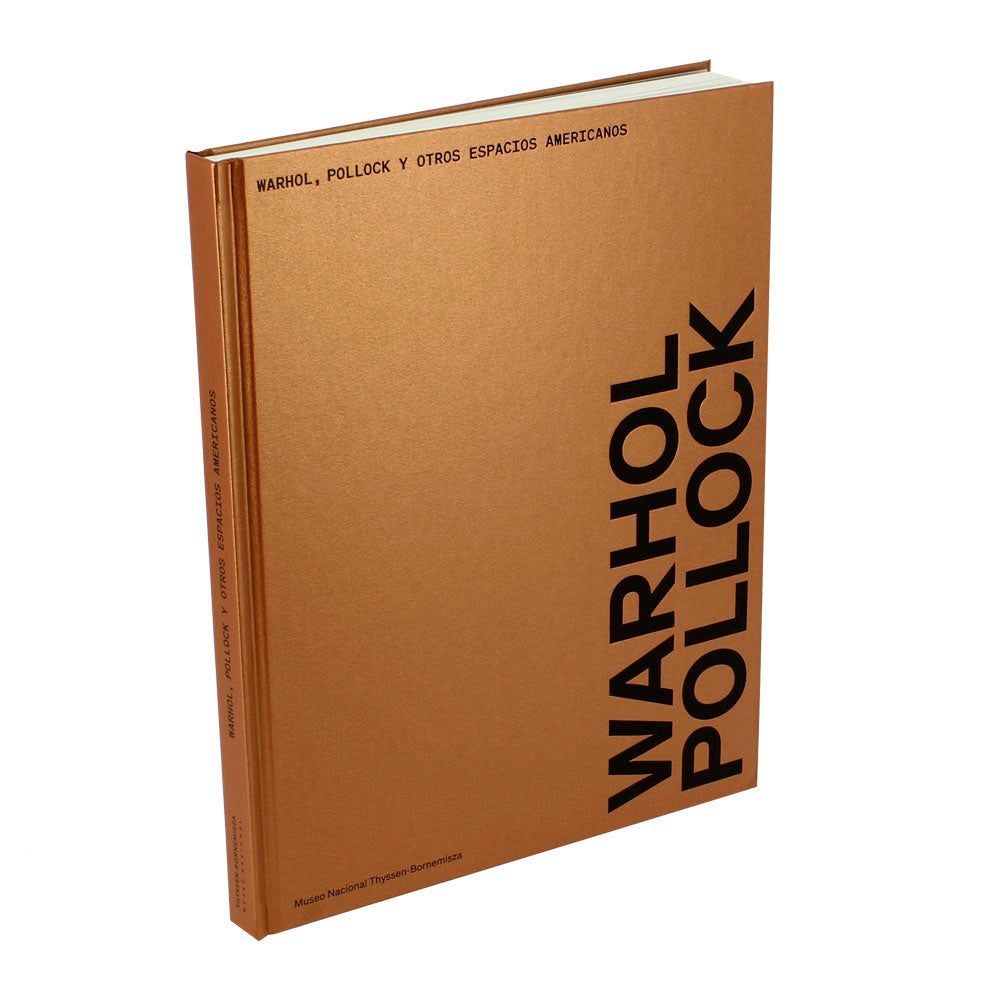
Closed format: 23 x 30 cm. Pages: 152 pages. Contents: 94 catalogued works. Includes an essay by Estrella de Diego, curator of the exhibition, an essay by Patrick Moore, former director of the Warhol Museum, and the transcript of a conversation between Estrella de Diego, Guillermo Kuitca (Argentine painter), and Guillermo Solana (artistic director of the Thyssen-Bornemisza National Museum). Produced with the support of the Pollock-Krasner Foundation.
Straight spine, headbands, printed endpapers; printed lining; stamping on cover and spine; 8-page fold-out sewn in the center of the sheet.
ISBN 9791387729080
Catalogue of the exhibition held at the Thyssen-Bornemisza National Museum from October 21, 2025 to January 25, 2026.
Traditionally, art history has presented Abstract Expressionism and Pop Art, and therefore each of their most famous representatives—Jackson Pollock and Andy Warhol—as opposing poles belonging to two distinct eras and styles: abstraction and figurative art. Furthermore, Pollock has been portrayed as an artist within the lineage of great creators, inspired and original, while for some, Warhol has been a mere appropriator of images and consumer goods. But what if things were actually different? What if there were affinities between Warhol and Pollock, beyond the former's oft-mentioned fascination with the latter? After all, Pollock was already a celebrated artist when Warhol entered the scene. He was a famous artist, and he died in 1956 in a modern and inexplicable car accident, at the height of his career, just like James Dean.
It's rarely discussed how Pollock and Warhol—and many other artists of that era—transitioned between abstraction and figuration at different points in their careers. Nor does anyone seem to pay attention to how returns in visual art never truly revert to the starting point, nor do they arrive without transformation. The perspective invented by the Italian Quattrocento—the vanishing point that governs Western space in figurative art—is completely rewritten in some of Pollock's works, and this subversion of traditional perspective marks Warhol's spaces when he considers returning to a figuration that is, to a certain extent, ambiguous, flat, and without a clear vanishing point.
While Pollock's abstractions retain figurative elements, Warhol's figurations shatter traditional space—the figure of Elvis, seemingly floating on a bottomless background, serves as an example. Perhaps in his works, Warhol speaks of space itself, and not merely of consumer goods and figures. In recent years, conventional art history has been reread and re-examined; it has rescued forgotten artists, countries with supposedly secondary roles, and historical moments once dismissed as less relevant to visual art and its evolution. Now, perhaps, the time has come to break down the categories that govern a way of thinking based on opposites that are often not truly opposites.
Ultimately, history is a journey. A line, a thread like those Pollock pursues in his paintings and that Warhol takes up again. For the first time in dialogue, Warhol and Pollock—along with other great American artists—invite us to look once more.
Includes an essay by Estrella de Diego, curator of the exhibition, an essay by Patrick Moore, former director of the Warhol Museum, and the transcript of a conversation between Estrella de Diego, Guillermo Kuitca (Argentine painter), and Guillermo Solana (artistic director of the Thyssen-Bornemisza National Museum) . Produced with the support of the Pollock-Krasner Foundation.
We offer shipping and in-store pickup. If you live in Madrid or plan to visit soon, you can select “In-Store Pickup” at no additional cost.
If you choose to have your order shipped to the address you provide, it will be delivered via a courier service, and you will be responsible for the shipping costs. You can view the shipping costs on the last page, after the cart and before payment. We do not ship to P.O. boxes. It is very important that you enter your address correctly and remember to include the floor, unit number, door number, etc., and ensure that the ZIP code is correct and provide with a phone number of the same country where the order is to be delivered. Otherwise, there may be delays or additional charges.
If you place your order from outside the EU or from the Canary Islands, Ceuta, and Melilla, you will not pay VAT; however, the amount you pay us does not include customs processing fees, duties, and taxes that the carrier may require you to pay before delivering your order.
We aim to have orders ready for pickup or shipped by the next business day after you place your order. Shipping to Spain typically takes 24–36 hours. For international shipments sent by air, please allow 3–5 days for delivery (not including customs processing times). In some countries where you can choose between air shipping and a more economical ground shipping option, delivery times are slightly longer if you choose the latter. If you order a print-on-demand reproduction, please allow 5 to 9 business days from the time you place your order until the reproduction is ready to ship or for in-store pickup. More information here
For cancellations or returns, except for Print-on-Demand orders, you can cancel your order and, if you have already received it, return the items you ordered within 14 calendar days of receiving or picking up the order and receive a refund for the total amount of the items you purchased. With some exceptions, if the order was shipped to mainland Spain, we will send a courier to pick it up and cover the round-trip shipping costs.
To make a return, please notify us as soon as possible by filling out the form available here
More information on cancellations/returns here
You might also be interested in